
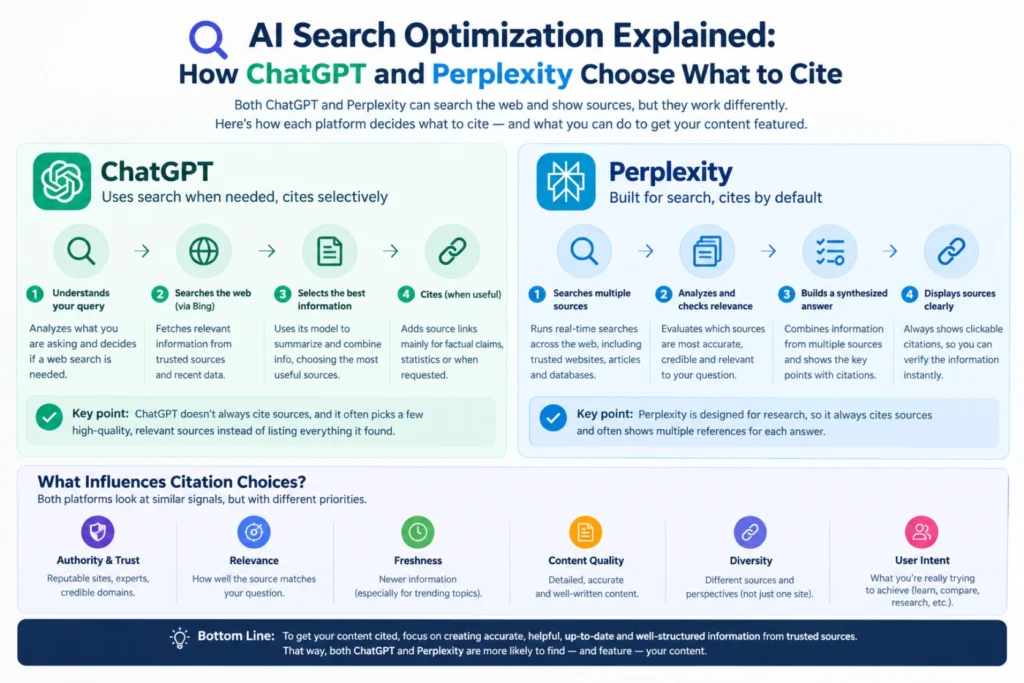
AI search tools favor content that directly and concisely answers a specific question, is backed by clear structure (headings, lists, FAQ schema), comes from a site with consistent topical authority, and is recent or regularly updated. They tend to skip content that buries the answer under long intros, lacks structured data, or reads as generic marketing copy rather than a real answer.
AI search doesn’t “rank” the way Google does
Classic search returns a list of links ranked by relevance and authority signals. AI search tools instead read multiple sources, synthesize an answer, and choose which sources to cite as support. That’s a fundamentally different task — it’s less “who ranks highest” and more “whose content is easiest to lift a clean, accurate answer from.”
This is why a page can rank #3 on Google and never get cited by ChatGPT, while a lesser-known competitor with better-structured content gets quoted directly.
What AI tools are actually looking for
A direct answer near the top.** If the first three sentences answer the question in plain terms, that’s easy to extract. If the answer is buried after two paragraphs of brand introduction, it’s easy to skip.
Clear structure.** Headings phrased as questions, short paragraphs, and lists make content easier to parse and cite accurately.
Structured data.** FAQPage and Article schema give AI crawlers a machine-readable version of your content, reducing the guesswork.
Specificity.** Concrete numbers, named examples, and clear opinions get cited more than vague, hedge-everything marketing language.
Freshness and consistency.** Sites that publish regularly on a topic build a pattern of authority that AI tools learn to trust over time for that subject.
What doesn’t seem to matter as much (yet)
– Domain age alone
– Backlink volume alone (still useful for classic SEO, less directly tied to AI citation)
– Visual design quality
A practical test you can run today
Pick five questions your customers actually ask. Type each one into ChatGPT or Perplexity and see who gets cited. If it’s never you, open the pages that do get cited and compare their structure to yours — in almost every case, the difference is answer clarity and formatting, not brand size.
FAQ
Does this replace SEO?
No — it sits on top of solid SEO fundamentals. A page with no organic visibility at all is unlikely to be cited by AI tools either.
How long does it take to see AI citations improve?
There’s no fixed timeline, but reformatting existing high-traffic pages with clear answer blocks and schema is the fastest lever available, often showing movement within weeks rather than months.
Do I need to write differently for AI tools versus human readers?
Not fundamentally — content that’s genuinely clear and well-structured serves both. The discipline of answering the question directly and early benefits human readers just as much as AI extraction.