
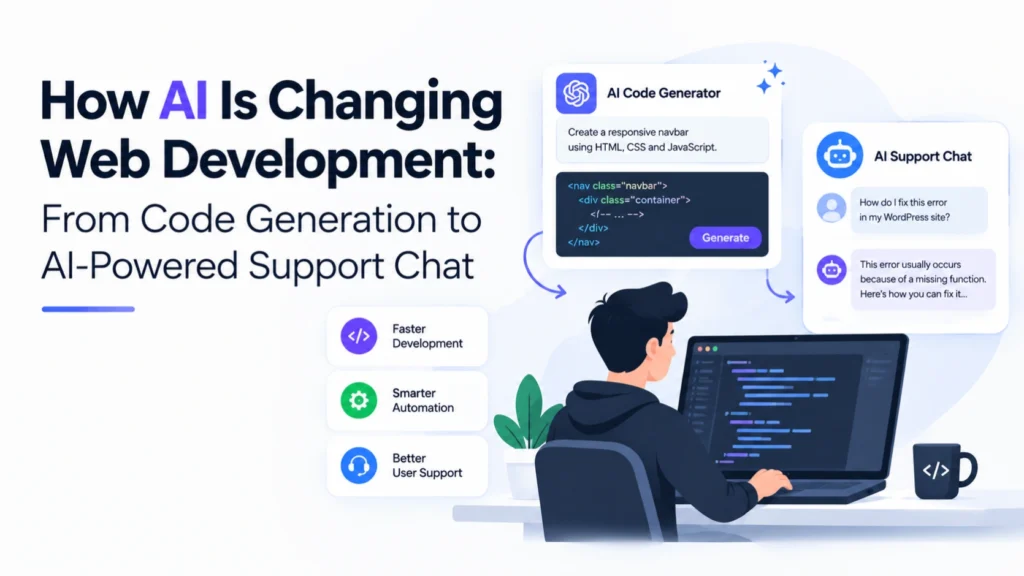
AI is changing web development in three practical ways: speeding up the build process itself (code generation, automated testing, faster prototyping), changing what gets built into websites (AI chat, personalization, smarter search), and changing how websites get found (AEO/GEO formatting for AI search tools). None of this replaces developers — it shifts where their time goes, from repetitive coding tasks toward architecture, review, and the features AI can’t design well on its own.
Where AI is speeding up the build process
Code generation for repetitive patterns — boilerplate components, standard layouts, and common functionality can be scaffolded faster, freeing developer time for custom logic and architecture decisions.
Automated testing — AI-assisted testing tools can catch more edge cases faster than manual testing alone, improving reliability without proportionally increasing QA time.
Faster prototyping — clients can see a working draft sooner, shortening the feedback loop before full development begins.
Where AI is changing what gets built
AI-powered chat and support — increasingly standard on business websites, handling common questions and routing complex ones to a human, rather than a static FAQ page alone.
–Personalization — content and product recommendations adjusting based on visitor behavior, previously only affordable for large enterprises, now more accessible to mid-sized businesses.
Smarter on-site search** — natural-language search that understands intent rather than requiring exact keyword matches.
Where AI is changing how websites get found
This is the part most businesses miss: it’s not just about building AI into your site, it’s about building your site so AI search tools can find and cite it. That means clean schema markup, direct-answer formatting, and clear structure — the AEO/GEO principles covered elsewhere on this blog. A beautifully built site that isn’t structured for AI-search visibility is increasingly leaving traffic on the table.
What isn’t changing
Good web development still requires understanding a business’s actual goals, making sound architecture decisions, and exercising judgment about tradeoffs — things AI tools assist with but don’t replace. The businesses getting the most value from AI in their development process are using it to move faster on the repetitive parts, not to skip the planning and judgment parts.
A realistic way to think about this
If you’re evaluating a development partner, ask how they’re using AI in their process — for speed and testing, that’s a genuine advantage. If the answer suggests AI is replacing actual planning, code review, and quality control, that’s a red flag regardless of how fast the initial output looks.
FAQ
Will AI eventually replace web developers entirely?
Unlikely in the foreseeable future — AI changes the mix of tasks developers spend time on, shifting toward architecture, review, and complex problem-solving rather than eliminating the role.
Should my business website have an AI chatbot?
It depends on your support volume and the type of questions you get — if you field repetitive questions regularly, an AI chatbot can meaningfully reduce response time and support load.
Does AI-assisted development cost less?
It can reduce time spent on repetitive tasks, which may lower cost or shorten timelines, but the quality of architecture and planning still depends on the developer’s judgment, not the tooling alone.