
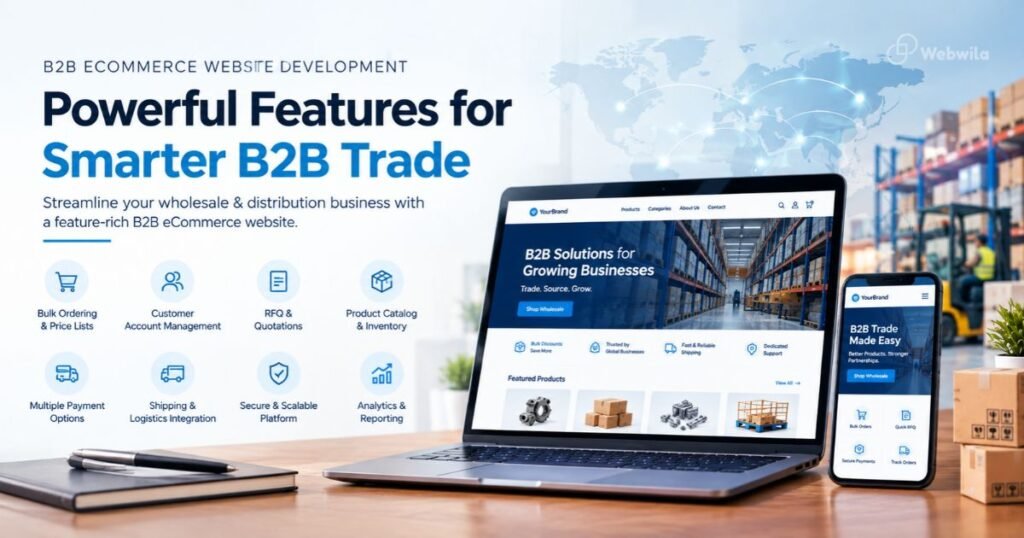
Quick answer: A B2B eCommerce website needs features that a standard consumer online store typically doesn’t include out of the box: tiered or account-specific pricing, bulk order and quick-reorder tools, a business account approval process, quote request functionality alongside standard checkout, and clear support for purchase orders and net payment terms. Bolting these onto a consumer-focused platform is possible but often clunky — which is why B2B eCommerce is increasingly treated as its own distinct category of website build rather than a slightly modified version of a B2C store.
Why B2B buyers need a fundamentally different online experience
A consumer buying one item for themselves and a procurement manager sourcing bulk inventory for their business are doing genuinely different tasks, even when both are technically “shopping online.” The procurement buyer usually needs to compare pricing at different order volumes, may need approval from someone else in their organization before finalizing a purchase, often needs to pay via invoice rather than a credit card, and frequently reorders the exact same items repeatedly rather than browsing for something new. A website built purely around the consumer shopping journey handles almost none of this well.
The features that actually matter for B2B eCommerce
Tiered or account-specific pricing. Many B2B relationships involve pricing that varies by customer — a long-standing client might get better rates than a new account, or pricing might scale down at higher order volumes. This requires the underlying platform to support pricing tied to logged-in account types or specific customer groups, which standard consumer-focused platforms often handle poorly or not at all without significant customization.
Bulk ordering and quick reorder tools. A B2B buyer restocking inventory doesn’t want to search for and individually add fifteen familiar products to a cart one at a time. Bulk order forms — where a buyer can enter quantities for multiple known SKUs at once, often via a simple table or even a CSV upload — and one-click reorder of a previous order dramatically reduce friction for repeat B2B customers specifically.
A business account approval process. Unlike consumer eCommerce, many B2B stores don’t want just anyone to see wholesale pricing or place an order without first being verified as a legitimate business. An account application and approval workflow, gating pricing and ordering behind verified business accounts, is a common and often necessary requirement that consumer platforms don’t build in by default.
Quote request functionality alongside standard checkout. Not every B2B transaction fits a fixed-price, add-to-cart model — larger or custom orders often need a formal quote process first. Supporting both a standard checkout flow for straightforward orders and a quote-request path for larger or custom ones, on the same platform, covers the real range of how B2B purchases actually happen.
Support for purchase orders and net payment terms. Many B2B buyers pay via purchase order against agreed net-30 or net-60 terms rather than a credit card at time of purchase. A platform that can’t accommodate this at all will quietly lose buyers who simply can’t complete a purchase the way their own organization requires them to pay.
Detailed product data for spec-driven purchasing decisions. B2B buyers, especially in industrial, agricultural, or technical product categories, often need detailed specifications, certifications, and technical documentation to make a purchasing decision — considerably more than the lifestyle-oriented product photography and short descriptions that drive consumer purchases.
Why this often requires a different platform decision than B2C
This connects directly to a broader platform question covered elsewhere on this blog: Shopify, in its standard form, is built primarily around the consumer shopping journey, and while B2B-specific extensions and apps exist, they can only go so far before hitting real limitations. WooCommerce, being more open and extensible by nature, can be built out more fully for B2B-specific workflows, but this requires deliberate custom development rather than a quick plugin install. For businesses with genuinely complex B2B requirements — tiered pricing, account approval, quote workflows all operating together — a custom build is frequently the more reliable long-term path, even though it costs more upfront than starting with an off-the-shelf B2B extension bolted onto a consumer platform.
The mistake we see most often
Businesses launch a B2B eCommerce site built on a standard consumer platform, add a few B2B-oriented apps to patch in tiered pricing or account gating, and then find themselves fighting the platform’s core assumptions every time a genuinely B2B requirement comes up that the consumer-oriented apps weren’t designed to handle. This isn’t a reason to avoid starting simple — it’s a reason to be honest early about how complex your actual B2B requirements are likely to become, so the platform decision matches your real trajectory rather than just your starting point.
FAQ
Can I start with a consumer eCommerce platform and add B2B features later? Yes, for straightforward B2B needs like basic tiered pricing, many platforms handle this reasonably well through apps or extensions. For more complex requirements — quote workflows, purchase order support, account approval — it’s worth evaluating this upfront rather than discovering the limitation after significant investment in the simpler platform.
Do I need separate B2B and B2C sites if I sell to both audiences? It depends on how different the two buying journeys genuinely are for your specific products — some businesses successfully run both on one platform with account-gated B2B pricing, while others find a genuinely separate B2B portal or site works better when the two audiences have substantially different needs.
How important is mobile experience for B2B eCommerce specifically? Still important, though B2B purchasing decisions are more likely to happen on desktop than typical consumer impulse purchases — but procurement staff do frequently research and reorder from mobile devices, so it shouldn’t be deprioritized entirely.
What’s a reasonable timeline for building a proper B2B eCommerce site? Given the added complexity of account workflows, pricing logic, and often payment term support, expect a meaningfully longer timeline than a standard consumer store — commonly eight to twelve or more weeks depending on how many custom workflows are required.