
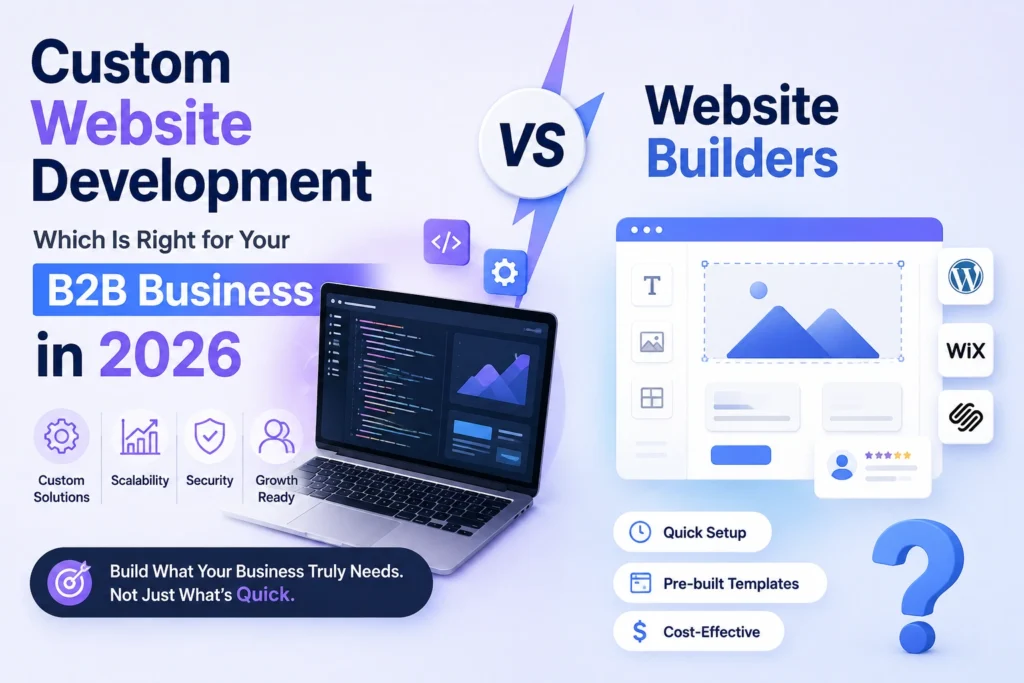
Quick answer: Website builders (Wix, Squarespace, basic WordPress themes) are cheaper and faster for very small or short-term sites. Custom website development costs more upfront but wins on scalability, page speed, SEO/AEO control, integrations, and long-term cost-per-lead for B2B companies planning to grow past a handful of pages. If you expect more than 20–30 pages, need custom integrations (CRM, quoting tools, portals), or compete on search visibility, custom development is the better investment.
The real difference isn’t design — it’s what happens after launch
Most comparisons focus on how the homepage looks. For a B2B business, that’s the wrong lens. The real difference shows up 6–12 months in:
| Factor | Website Builder | Custom Development |
|---|---|---|
| Upfront cost | Low ($0–$500) | Moderate to high (varies by scope) |
| Ongoing cost | Monthly subscription, locked to platform | One-time build + optional maintenance plan |
| Page speed at scale | Degrades as pages/plugins grow | Built and optimized for your actual content volume |
| SEO/AEO control | Limited — templated schema, restricted code access | Full control over schema, structured data, answer-block formatting |
| Integrations (CRM, quoting, portals) | Limited to available plugins/apps | Built to spec, no workaround needed |
| Ownership | You’re renting the platform | You own the code and hosting |
| Scalability | Hits a ceiling fast | Grows with the business |
When a website builder genuinely makes sense
- You need a placeholder site live this week for a very small operation
- You have one product/service and don’t expect to add pages or complexity
- Budget is the only constraint and the site isn’t a primary lead source
When custom development pays for itself
- You’re a B2B service business relying on the website for qualified leads
- You need the site to rank in both classic search and AI answer engines (AEO), which requires schema and structure most builders restrict
- You’ll be adding service pages, case studies, and blog content regularly (which builders slow down significantly past ~50 pages)
- You need integrations — a quote calculator, a client portal, a CRM sync — that off-the-shelf builders can’t do cleanly
- Site speed directly affects your conversion rate (it does — every extra second of load time measurably reduces B2B form submissions)
The AEO angle most comparisons miss
Answer engines like ChatGPT, Perplexity, and Google’s AI Overviews reward sites with clean schema markup, fast load times, and direct-answer formatting. Website builders typically generate bloated, template-based code and restrict how much schema you can customize. Custom-built sites let you control exactly how your service pages, FAQs, and case studies are marked up — which is increasingly the difference between showing up in an AI-generated answer and being invisible to it.
Our recommendation
If your website is a genuine growth channel — not just a digital business card — custom development is the investment that keeps paying off as you add content, services, and integrations. If it’s a placeholder while you validate an idea, start with a builder and plan to migrate once you have traction.
FAQ
Is custom development always more expensive long-term? Not necessarily. Website builder subscriptions compound over years and you never own the underlying platform. Custom development is a larger one-time cost with lower ongoing costs and full ownership.
Can I switch from a website builder to custom development later? Yes, and many businesses do exactly this once they outgrow the builder’s limitations — but a proper migration preserves your existing SEO rankings, which takes planning.
Does a website builder hurt my SEO? It doesn’t automatically hurt it, but it limits your control over technical SEO and structured data — both of which matter more now that AI answer engines factor into visibility alongside classic search.