
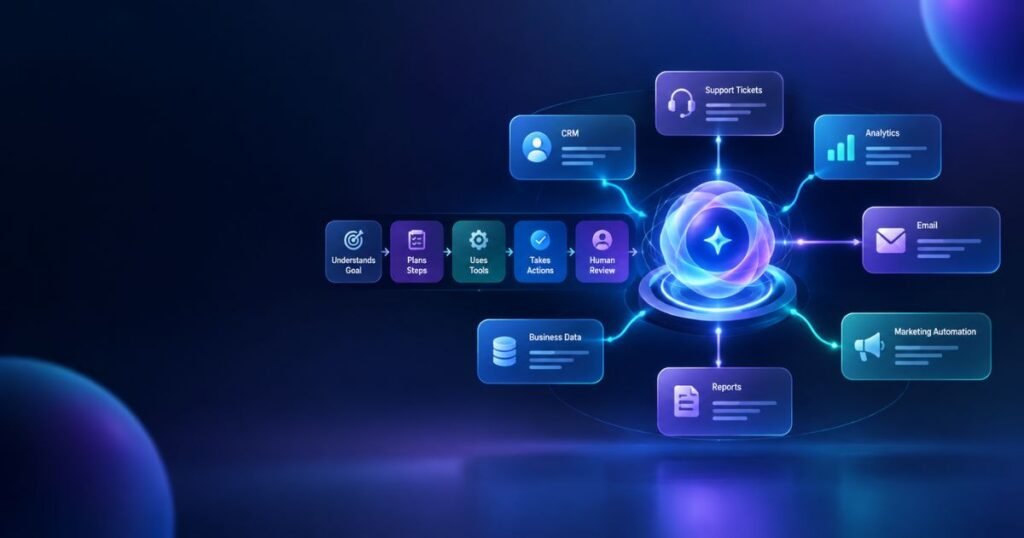
Quick answer: Agentic AI refers to AI systems that can complete multi-step tasks on their own — deciding what to do next, taking actions across tools, and only looping in a human when needed — rather than just answering a single question when asked. Large employers are already rolling these out company-wide for internal workflows. Most small and mid-sized businesses don’t need to build custom agents yet, but should understand the concept because many everyday tools (CRMs, support platforms, marketing software) are quietly adding agentic features into products you likely already use.
The difference between a chatbot and an agent, in plain terms
A chatbot answers a question you ask it. An agent is given a goal — “triage today’s support tickets” or “draft a weekly report from our sales data” — and works through the steps needed to get there, checking tools, making decisions along the way, and flagging anything it’s unsure about for a human to review.
Large companies are already deploying this at scale: some are rolling out personalized AI agents to their entire workforce that use each employee’s role and recent activity to automate routine tasks, while cybersecurity vendors are building partner programs specifically around certifying and reselling AI agents for tasks like automated threat detection and response.
Why this matters even if you’re not building agents yourself
You don’t need to build a custom AI agent to be affected by this trend. It matters because:
- Software you already use is adding agentic features. CRMs, help desks, and marketing platforms are increasingly shipping “automate this workflow” features built on the same underlying approach.
- Your competitors may start automating tasks you’re still doing manually. Ticket triage, report generation, lead qualification — which changes response times and operating costs.
- Vendor evaluation is getting more complex. When you’re choosing software, “does it have agentic automation” is becoming a real feature comparison point, not a gimmick.
Should you actually adopt this now?
For most small and mid-sized businesses, the practical move isn’t building custom AI agents — it’s checking whether the software you already pay for (support desk, CRM, email marketing) has added agentic automation features you’re not using yet. That’s a much lower-risk, lower-cost way to get the benefit without the complexity of building something from scratch.
A reasonable way to start
- List your 3 most repetitive, rules-based tasks (ticket sorting, follow-up emails, report compilation).
- Check whether your existing tools already offer an “automate” or “AI workflow” feature for any of them.
- Turn on one, monitor it for a month before trusting it fully, and only then consider expanding.
FAQ
Is agentic AI the same as a chatbot on my website?
No — a chatbot answers questions in a conversation. An agent completes multi-step tasks and takes actions, sometimes without a human prompting each step.
Is this only relevant to large enterprises?
No — the underlying features are increasingly built into everyday small-business software, just under less dramatic names like “workflow automation” or “smart assist.”
What’s the biggest risk of adopting agentic AI too early?
Trusting an automated workflow with a task before verifying its output for long enough — start with low-stakes, easily-reviewed tasks first.