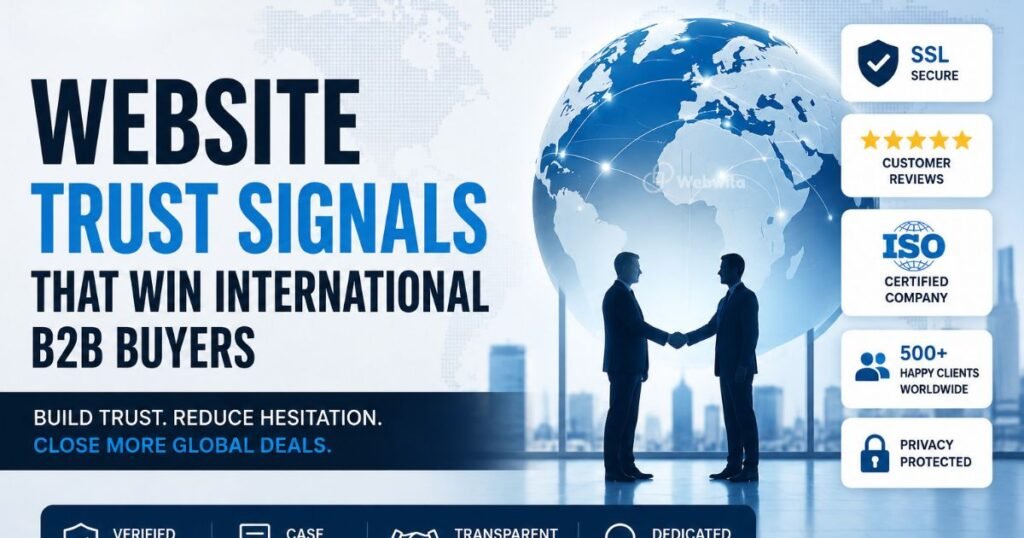
Quick answer: International B2B buyers evaluating an unfamiliar supplier’s website look for specific, concrete trust signals before reaching out: visible certifications and compliance documentation, clearly stated MOQs and terms, genuine photography of the actual facility and product, specific operational details (years in business, markets served, export volume where shareable), and a clear, responsive way to make direct contact with a real person rather than only a generic form. Vague, polished marketing language without these specifics tends to slow down or entirely prevent a serious buyer from making first contact, regardless of how professional the overall design looks.
Why trust signals matter more here than in almost any other business category
Most B2B purchasing decisions involve some degree of trust-building before a buyer commits. International trade takes this further: the buyer is often evaluating a supplier in a different country, with a different legal and regulatory environment, that they may never visit in person before placing a significant order. This combination of distance, unfamiliarity, and real financial risk means trust signals aren’t a nice-to-have on an international B2B website — they’re often the single deciding factor in whether a buyer reaches out at all, let alone eventually places an order.
The specific trust signals that actually move the needle
Certifications and compliance documentation, shown specifically rather than referenced vaguely. “We meet international quality standards” tells a buyer nothing concrete. Naming the specific certification, showing it where possible, and explaining briefly what it actually covers gives a buyer something real to evaluate and, often, to independently verify.
Clearly stated MOQs, pricing terms, and shipping terms. Ambiguity here reads as either disorganization or, worse, as something being deliberately hidden. Buyers who’ve been burned before by suppliers with unclear terms are specifically looking for clarity as an early signal of reliability.
Genuine, specific photography — not stock imagery. This is one of the fastest trust signals to evaluate and one of the easiest for a buyer to spot as fake. Real photos of your actual facility, your actual product, and ideally your actual team communicate legitimacy in a way that no amount of well-written copy can fully replace. If your current site relies heavily on stock photography, this is often one of the highest-leverage, relatively low-cost fixes available.
Specific operational details. Years in business, specific export markets currently served, approximate scale of operations where you’re comfortable sharing it — these details, stated specifically rather than vaguely, help a buyer place you within a credible operational context rather than leaving them to guess whether they’re dealing with an established operation or a very new, unproven one.
Client references or market presence, where shareable. Not every trade business can publish detailed client lists for confidentiality reasons, but even general statements — “supplying to distributors across 12 countries” or industry association memberships — provide meaningful third-party-adjacent credibility that pure self-description can’t offer on its own.
A real, responsive point of contact. A generic contact form that disappears into an unclear process erodes confidence, especially for a buyer taking the real risk of reaching out to an unfamiliar international supplier for the first time. Clear expectations about response time, and evidence of a real person or team behind the business, meaningfully reduce the perceived risk of that first contact.
The trust signals that sound good but don’t actually work
It’s worth being direct about a few common patterns that businesses invest in believing they build trust, but that experienced international buyers have largely learned to discount: generic testimonial quotes with no specific detail or attribution, vague superlative language (“world-class,” “premium,” “trusted by many”) without anything concrete behind it, and stock photography clearly sourced from a generic image library rather than the actual business. These elements aren’t actively harmful, but they also don’t do the trust-building work businesses often assume they do, and time spent polishing this kind of generic content is often better redirected toward the specific, concrete signals covered above.
How this connects to search and AI visibility
There’s a useful overlap worth noting here: the same specific, concrete content that builds human buyer trust — named certifications, specific operational details, clear terms — is also exactly the kind of content that performs well for both classic SEO and AI answer engine visibility, covered in more depth elsewhere on this blog. Vague marketing language doesn’t just fail to build buyer trust; it also gives search engines and AI tools very little specific, extractable information to work with when a buyer is searching for or asking about a supplier like yours. Investing in specificity solves both problems at once, which is part of why it’s consistently one of the highest-leverage changes available to an international trade website.
A practical audit you can run on your own site today
Go through your own website as if you were a buyer evaluating an unfamiliar supplier for the first time, and honestly ask: could I identify your specific certifications without having to ask? Do I know your MOQs and general terms without submitting an inquiry first? Have I seen real photos of your actual operation, or only generic imagery? Do I have any sense of how established and experienced this business actually is? Wherever the honest answer is no, that’s a specific, addressable gap — not a vague “our website needs work” problem, but a concrete list of what to fix first.
FAQ
Do trust signals matter as much for buyers who already know us personally? Less so for existing relationships, but the website still matters for new inquiries and for anyone doing due diligence before an introduction turns into a first order — most trade businesses are trying to grow beyond their existing personal network, and the website is doing that trust-building work for buyers who don’t have a personal connection yet.
Is it worth getting third-party certifications specifically to display on the website? If a relevant certification genuinely applies to your product category and target markets, yes — the cost of obtaining and maintaining it is often justified by the trust and market access it opens up, well beyond its value as website content alone.
Should we show pricing publicly to build trust, or keep it inquiry-based? This varies by product and market norms in your specific category — what matters more consistently than public pricing itself is clarity about terms and MOQs, whether or not exact pricing is publicly displayed.
How often should these trust elements be updated? Certifications and operational details should be reviewed at least annually to ensure accuracy, and photography is worth refreshing periodically as your facility, product line, or team evolves, since outdated or clearly old imagery can itself become a subtle trust issue over time.