
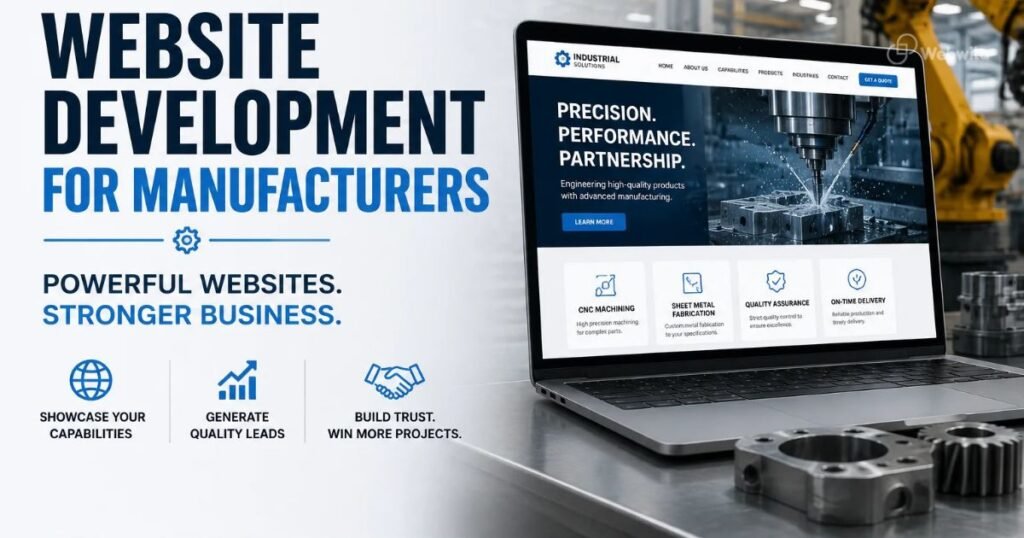
Quick answer: A manufacturer’s website needs to function less like a catalog and more like a technical sales tool: detailed spec sheets and downloadable documentation, clear capability pages describing what you can actually produce (materials, tolerances, volumes, customization), certifications relevant to your industry, and a request-for-quote (RFQ) system rather than a standard eCommerce checkout. Buyers evaluating a manufacturer are typically engineers, procurement specialists, or product managers who need technical confidence before they’ll even request a quote, and a website built around generic product photography and vague descriptions fails that audience immediately.
Why manufacturer websites are judged differently than almost any other B2B category
A buyer sourcing a manufactured component or product is rarely making a quick decision. They’re often qualifying your business as a potential long-term supplier, evaluating whether you can actually meet their specific technical requirements, and frequently need to bring documentation back to an internal engineering or procurement team before any purchase conversation can move forward. This means the website’s job isn’t just to look credible — it needs to actually contain the specific technical information that lets a buyer self-qualify you as a viable option before they ever pick up the phone or send an email.
What a manufacturer’s website actually needs
Detailed, downloadable spec sheets and technical documentation. Buyers evaluating a manufacturer need concrete data — material specifications, tolerances, dimensions, capacity, compliance standards — not marketing descriptions. Making this available as downloadable PDFs alongside the on-page content serves buyers who need to share documentation internally with their own technical teams.
Clear capability pages, not just a product catalog. Many manufacturers do custom or semi-custom work in addition to standard products. A dedicated page explaining your actual production capabilities — materials you work with, volume ranges, customization options, typical lead times — helps a buyer with a non-standard requirement understand whether it’s worth reaching out at all, rather than assuming you only offer exactly what’s shown in a fixed product catalog.
Industry-relevant certifications, shown specifically. Whatever’s relevant to your sector — ISO certifications, industry-specific quality standards, compliance with destination-market regulations — should be named and, where possible, shown as actual documentation, not just referenced in passing as “we maintain high quality standards.”
An RFQ (request for quote) system, not a standard checkout. Manufactured products, especially custom or semi-custom ones, rarely fit a fixed-price, add-to-cart model. A structured RFQ form that captures specifications, quantities, and intended application gives you genuinely useful information to quote accurately, and gives the buyer a process that matches how they actually expect to source manufactured goods.
Case studies organized by industry or application, not just by product. A buyer in, say, the automotive sector wants to see that you’ve successfully supplied automotive-sector clients before, specifically. Organizing case studies and project examples by industry or application, rather than purely by product type, helps a buyer quickly find proof relevant to their specific situation.
Clear information about production capacity and lead times. Procurement buyers evaluating a new manufacturing partner need to understand whether you can actually meet their volume and timeline requirements before investing time in a detailed RFQ — vague or missing information here creates unnecessary friction and unqualified inquiries in both directions.
The trust problem, applied to a technical audience
Similar to the trust-building challenge covered in our post on international trade websites, manufacturer websites are solving a trust problem — but for a more technically sophisticated audience specifically evaluating capability and reliability rather than general business legitimacy alone. Vague claims like “high-quality manufacturing” or “trusted by industry leaders” carry very little weight with an engineer or procurement specialist who’s trained to evaluate specific, verifiable claims. Specificity — actual tolerances, actual certifications, actual case studies with real detail — is what actually moves this audience toward a genuine inquiry.
SEO and AEO considerations specific to manufacturers
Buyers researching manufacturers often search using highly specific technical terms — a material name plus a process, a tolerance specification, an industry-specific application. This is a case where genuinely detailed, specification-rich content isn’t just good for buyer trust; it’s also precisely the kind of content that ranks well for these specific, lower-competition, high-intent search terms, and that AI search tools can confidently extract and cite when a buyer asks a technical sourcing question. A manufacturer with thin, generic product pages is both harder to find for the specific terms that matter and less likely to be surfaced by AI tools trying to answer a detailed technical sourcing question.
FAQ
Should pricing be shown publicly on a manufacturer’s website? Rarely for custom or semi-custom manufacturing, since pricing depends heavily on specification and volume — an RFQ process is usually the more appropriate model than public pricing, though standard, non-custom products can sometimes support published pricing.
How technical should the website content actually be? Detailed enough to let a qualified technical buyer self-assess fit, but organized so a less technical buyer (a purchasing manager rather than an engineer, for instance) can still navigate to what they need — layering a clear overview with detailed downloadable documentation underneath serves both audiences well.
Is video content worth investing in for a manufacturer’s website? Often yes — video of your actual production process or facility is a strong trust and credibility signal for this audience specifically, arguably even more effective than static photography at communicating real operational capability.
What’s the most common gap you see on manufacturer websites? Thin, generic product descriptions with no real specification detail, combined with no clear RFQ process — buyers interested enough to want a quote are often left with only a generic contact form that doesn’t capture the technical detail needed to respond meaningfully.