Quick answer: A wholesale or distribution website needs to be built around repeat, account-based buying rather than one-off discovery purchases: gated or tiered pricing for approved accounts, fast reorder and bulk-order tools, clear territory or dealer network information where relevant, and inventory or availability visibility so buyers aren’t placing orders blind. The buyer relationship here is usually ongoing, not transactional, which should shape almost every design and feature decision on the site.
Why distribution businesses have a different website job than either retailers or manufacturers
A wholesaler or distributor sits in the middle of a supply chain — buying from manufacturers or producers and selling to retailers, other businesses, or sometimes a mix of both. This middle position creates a specific website requirement that’s easy to overlook: the site often needs to serve two different relationships at once, inbound sourcing relationships and outbound account-based selling relationships, while still presenting a clear, coherent experience to the specific audience actually visiting at any given time.
For most distribution businesses, though, the outbound side — serving existing and prospective buyer accounts — is where the website does the most ongoing work, and it’s worth being deliberate about building for that relationship specifically rather than defaulting to a generic company website structure.
What a distribution website actually needs
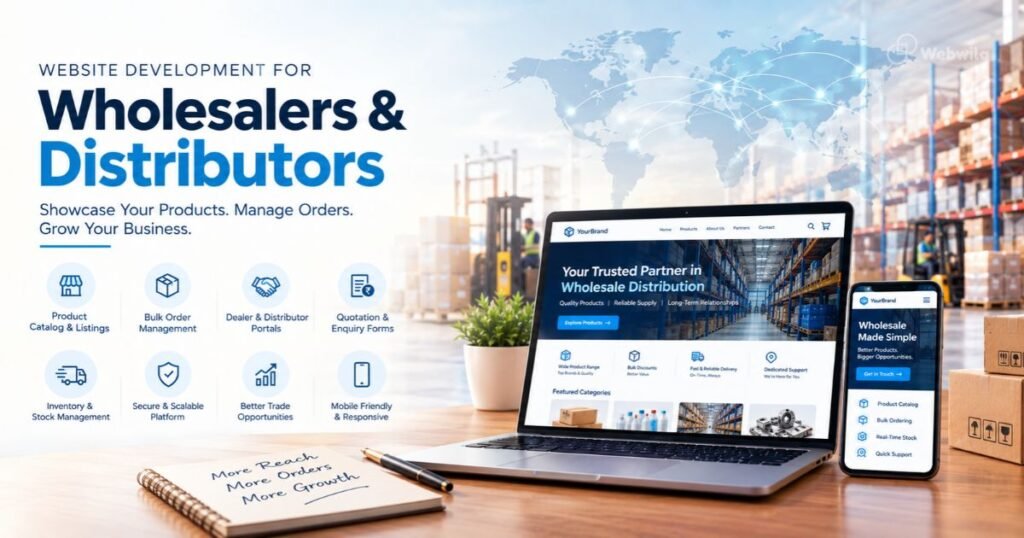
Account-gated or tiered pricing. Distributors frequently have different pricing for different buyer tiers — a large retail chain buying at volume typically has different terms than a small independent buyer. The site needs pricing logic tied to verified, logged-in accounts rather than flat public pricing, similar to the account-based functionality covered in our B2B eCommerce features post, but often with more tiers and more account-specific nuance than a typical B2B store.
Fast reorder tools built around how distribution buyers actually operate. Distribution buyers are overwhelmingly repeat buyers reordering known products on a recurring basis, often at scheduled intervals. A site that requires rebrowsing a full catalog every time, rather than supporting quick reorder of previous orders or saved order templates, creates real friction for exactly the buyers you most want to retain.
Inventory or availability visibility. Few things frustrate a wholesale buyer more than placing an order only to find out afterward that an item is out of stock or on backorder. Showing real-time or reasonably current availability, even approximately, helps buyers plan and builds confidence that they’re dealing with a well-run operation.
Clear territory, dealer, or account manager information where relevant. Many distribution businesses operate through assigned territories or dedicated account managers. Making it easy for a buyer to identify or reach their specific contact, rather than funneling everyone through a single generic inquiry form, reflects how the actual relationship works and reduces friction in getting a real response.
Minimum order requirements and shipping/freight terms stated clearly. Similar to the import-export context covered in our trade website post, ambiguity around order minimums and shipping terms creates unnecessary friction and unqualified inquiries — stating this clearly upfront is a small thing that saves meaningful back-and-forth for both sides.
New product and catalog update visibility. Distribution buyers often want to know what’s new or recently added without having to rebrowse an entire catalog. A clear “new products” or “recently added” section, potentially paired with an email or notification option, keeps existing accounts engaged between routine reorder cycles.
The relationship-first mindset this requires
It’s worth naming directly what distinguishes distribution website strategy from a typical consumer or even general B2B eCommerce approach: the primary job isn’t acquiring a new one-time customer, it’s serving and retaining an existing account relationship efficiently, while still providing a reasonable path for new prospective accounts to apply and get approved. Every feature decision should be evaluated against the question: does this make it easier for an existing, approved buyer to reorder quickly and reliably? If a feature primarily serves first-time discovery at the expense of repeat-buyer efficiency, it’s worth questioning whether it belongs prominently on a distribution-focused site at all.
SEO considerations specific to distribution businesses
Distribution businesses often have a more mixed search profile than manufacturers or trade companies — some searches come from prospective new accounts researching suppliers (similar to the sourcing-intent searches covered in our trade SEO post), while a meaningful share of existing-account traffic is navigational or direct rather than search-driven, since repeat buyers already know where to go. This means SEO investment is usually most valuable on the new-account-acquisition side: category and product pages structured to rank for the sourcing-oriented searches a prospective new buyer would use, alongside clear information about how to apply for an account, which is itself a meaningful page prospective buyers specifically look for and search for by name.
FAQ
Should pricing be visible to the public, or only to approved accounts? This varies by industry norm and competitive sensitivity — many distributors keep pricing gated behind account approval specifically to protect negotiated terms from competitors, while others use general published pricing as a lead-generation tool; the right choice depends on your specific market dynamics.
How important is mobile functionality for a wholesale reordering site? Quite important in practice — many buyers place routine reorders from a phone, particularly for quick, familiar reorders rather than first-time research, so the reorder and account functionality specifically should be tested thoroughly on mobile, not just the general browsing experience.
Do we need a separate new-account application process built into the site? Generally yes if account approval is part of your model — a clear, specific application process (rather than a generic contact form) sets expectations properly and captures the information you actually need to evaluate and onboard a new account efficiently.
What’s the most common website gap you see in distribution businesses? Sites built around first-time discovery and browsing, with weak or absent reorder and account-specific functionality — even though the majority of actual revenue typically comes from efficiently serving existing accounts rather than one-off new buyers.