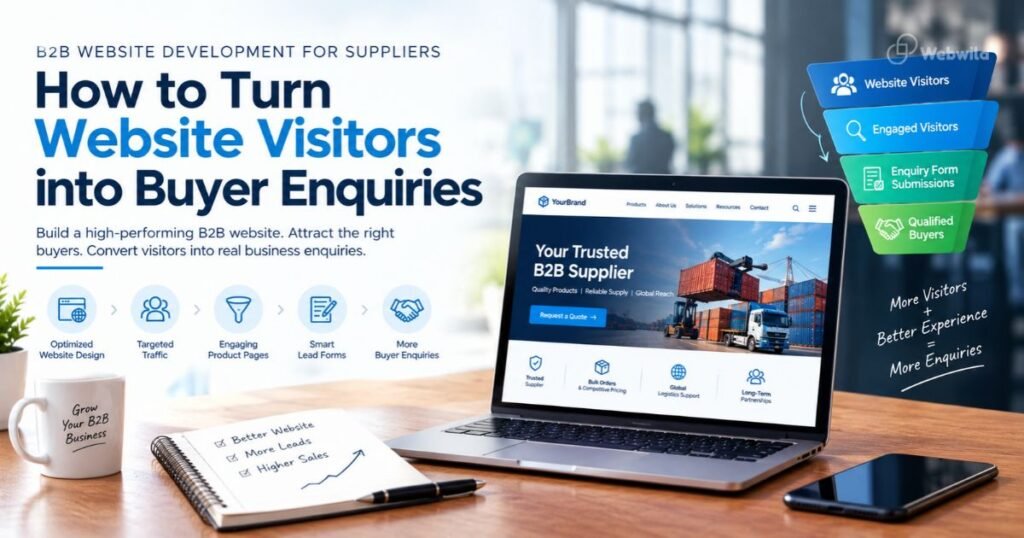
For a B2B supplier, your website is more than an online brochure. It is often the first place a potential buyer checks your products, capabilities, certifications, locations, delivery coverage and credibility before deciding whether to contact you.
A well-built B2B website should make that decision easier. It should help the right buyer find you through Google, understand what you supply, trust your business and submit a qualified enquiry with minimal friction.
Why Suppliers Need a Different Kind of Website
A typical business website may focus mainly on branding and basic company information. A supplier website has a bigger job: it needs to support product discovery, buyer research and enquiry generation.
Buyers may search for a product, specification, application, quantity, location or supplier type. Your website should provide enough useful information to answer those questions before the buyer reaches out.
| Regular Business Website | B2B Supplier Website |
|---|---|
| General company information | Clear products, categories and capabilities |
| Simple contact form | Enquiry, RFQ and bulk-order pathways |
| Brand-focused messaging | Buyer-focused information and proof |
| Basic service pages | Detailed product and application pages |
| Limited trust signals | Certifications, industries, clients and case studies |
1. Build Clear Product and Category Pages
One of the biggest mistakes suppliers make is putting every product into one generic catalogue page. Search engines and buyers both benefit when important product categories have dedicated, useful pages.
A strong product page can include product specifications, applications, available variants, minimum order information where appropriate, packaging or delivery information, industries served, certifications and a clear enquiry CTA.
2. Make Buyer Enquiries Easy
The purpose of a supplier website is not simply to generate traffic. It should turn relevant traffic into conversations.
Use visible calls to action such as Request a Quote, Send an Enquiry, Talk to Our Sales Team or WhatsApp Us. Keep enquiry forms focused on information that actually helps your sales team qualify the requirement.
- Name and company
- Business email or phone
- Product or service required
- Quantity or project requirement, when relevant
- Destination or location, when relevant
- Message or specifications
3. Show Why Buyers Should Trust You
For B2B buyers, especially new buyers, trust can determine whether an enquiry is submitted. Your website should make important credibility information easy to find.
- Years of experience
- Industries served
- Certifications and compliance information
- Manufacturing or sourcing capabilities
- Quality-control processes
- Client or project examples
- Export markets or service locations
- Company address and contact information
For international buyers, these signals become even more important. See our guide to website trust signals for international B2B buyers.
4. Design for Google Search and Buyer Intent
A supplier website should be structured around the way buyers search. Instead of relying only on broad terms such as “supplier” or “manufacturer”, create useful pages around specific products, applications, industries, locations and commercial requirements.
For example, a business may have opportunities around searches combining a product with terms such as manufacturer, supplier, exporter, bulk, wholesale, industrial or a target location.
This is where SEO becomes part of the website architecture rather than something added after development.
5. Build Pages That Support the Entire Buyer Journey
Different visitors arrive with different levels of intent. Someone discovering your company for the first time needs an overview, while a buyer comparing suppliers may need specifications, certifications, delivery information and a direct enquiry option.
- Discovery: The buyer finds your page through Google or another search channel.
- Understanding: They quickly understand what you supply and who you serve.
- Validation: They review capabilities, proof, certifications and business information.
- Evaluation: They compare your offering with alternatives.
- Enquiry: They request pricing, availability, samples or more information.
- Follow-up: Your sales team receives useful enquiry information.
6. Connect Your Website to Your B2B Marketing Strategy
Your website should not operate separately from your marketing. SEO, Google Business Profile, social media, paid campaigns, email outreach and AI search visibility should all lead prospects toward useful, conversion-focused pages.
For businesses that need a broader approach, our business growth services can support the website, visibility and lead-generation side together.
7. Make the Website Easy for AI Search to Understand
Search behaviour is changing. Buyers increasingly use AI-powered search and answer platforms to research suppliers, products and service providers. A B2B website should therefore present clear, factual and well-structured information that can be understood by both people and search systems.
Clear company information, descriptive headings, useful FAQs, strong internal linking, structured data and consistent business details can all contribute to a stronger foundation for modern search visibility.
8. Don’t Forget Mobile Performance and Speed
B2B buyers do not always research from a desktop. A supplier website should work properly on phones and tablets, load efficiently and make important actions easy to access.
Speed also affects the user experience. A visitor who cannot quickly reach a product, specification or enquiry form is less likely to continue.
What a High-Converting B2B Supplier Website Should Include
- Clear homepage value proposition
- Product and category architecture
- Detailed product/service pages
- Request-a-quote or enquiry forms
- WhatsApp or direct contact option where appropriate
- Industries and applications served
- Company capabilities
- Certifications and quality information
- Case studies and project proof
- Buyer-focused FAQs
- Search-friendly page structure
- Analytics and conversion tracking
- Mobile-friendly responsive design
- Fast, secure technical foundation
How WebWila Approaches B2B Website Development
At WebWila, we approach B2B website development around three connected goals: visibility, buyer trust and qualified enquiries.
That means the website architecture, content, user experience and conversion paths are planned together rather than treating design and SEO as separate activities.
If your current website is not generating the quality of enquiries you want, our B2B Website Development service is designed specifically for manufacturers, suppliers, exporters, importers, wholesalers, distributors and other B2B businesses.
Final Takeaway
A supplier website should do much more than tell visitors that your company exists. It should help the right buyers discover your business, understand your offering, verify your credibility and take the next step.
The strongest B2B websites are built around the buyer journey from the beginning. When product architecture, trust signals, SEO, user experience and enquiry conversion work together, your website becomes a genuine business-development asset rather than just an online brochure.
Frequently Asked Questions
What is B2B website development?
B2B website development is the process of building a website specifically for businesses that sell products or services to other businesses. It typically places greater emphasis on product information, buyer research, trust signals, enquiries and lead qualification.
What should a supplier website include?
A supplier website should generally include clear product or service pages, company capabilities, industries served, trust signals, certifications where relevant, enquiry or quote forms, contact options and search-friendly content.
Can a supplier website generate leads from Google?
Yes. A technically sound website with useful, search-focused pages can attract relevant visitors from Google and convert them through clear product information and enquiry pathways. SEO should be planned into the website structure from the beginning.
Should B2B suppliers have separate product pages?
For important products and categories, dedicated pages are often useful because they give buyers more relevant information and create more focused opportunities to appear for specific searches.
How can a B2B website get more qualified enquiries?
Start by targeting the right buyer searches, provide enough information to pre-qualify interest, show credible proof and make the enquiry process simple. Strong calls to action and focused forms can reduce unnecessary friction.
Want a B2B website built around visibility and qualified enquiries? Talk to WebWila about your website requirements.